

Derek Ting didn’t set out to disrupt the telecom industry. The University of Waterloo computer engineering student was trying to create his own co-op term and make enough money to cover rent, with the occasional slice of pizza and ramen along the way.
What began as a DIY co-op in 2009 soon became a startup. Ting and his co-founder spent their final co-op term building mobile apps, with TextNow emerging as the most successful.
Seventeen years later, TextNow has surpassed $1 billion in lifetime revenue with just a $1.5-million seed round in 2011 and no outside funding since.
“We came a long way, and our ambitions have grown a lot,” said Ting, co-founder and CEO of TextNow.
TextNow marked the milestone on Sept. 17 during Waterloo Tech Week, gathering past and present employees and members of the local tech community at its headquarters in the University of Waterloo’s David Johnston Research + Technology Park.
“This story isn’t about a number, it’s about how it happened,” said TextNow Chief Operating Officer Lindsay Gibson. “TextNow was born and bred right here in Waterloo.”
.png)
Outside the building, the company unveiled Équilibre Oblique, a permanent public sculpture by Canadian artist Philippe Pallafray. Its three forms represent an idea, a startup and a company at scale. Its mirrored surface reflects the people who stop in front of it, putting the next generation of builders into the picture.
“It’s not a monument for TextNow,” Gibson said. “It’s an invitation for teams working hard on building in this region.”
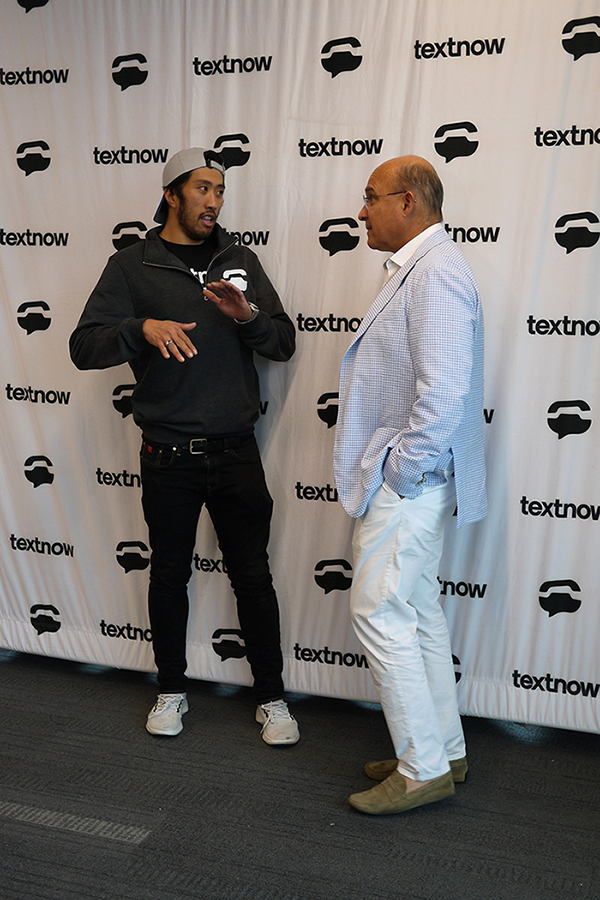
Among those celebrating was Jim Balsillie, chair of the Council of Canadian Innovators and former co-CEO of Research In Motion (BlackBerry). A friend and mentor to Ting, Balsillie said TextNow’s success is a reminder that scaling a tech firm rarely follows a straight line.
“There are mistakes, setbacks and moments where conventional wisdom tells you to go one way but your instincts tell you to go another,” he said.
“Success has a way of becoming part of the community’s story also,” he said. “People see what they’ve built, learn from their experience, and begin to imagine what they can build themselves.”
“It’s a bit surreal,” Ting said. “It’s crazy how far we came because that wasn’t part of the plan. The plan was just to make enough money to survive.”
The co-op term that found its calling
TextNow’s path to $1 billion started with a much smaller goal.
“I wanted a co-op term that was fun, close to campus so I could hang out with my friends, and the last one, which was the hard one, was I needed a co-op term that could pay the bills,” Ting said.
Ting and his co-founder started a company and began building mobile apps. As the startup grew, it found a cubicle at the Accelerator Centre in Waterloo, where Ting said the team benefited from affordable office space and advice on building a business. The team had several apps on the go, but one started to stand out.
“TextNow was our most successful app,” Ting said.
The idea came from what Ting described as his own “personal cheapness” and his frustration with paying extra for texting.
“I thought it was the biggest ripoff,” he said.
Ting had been texting people for free over the internet since he was a teenager. With the internet now in his pocket, he wondered why he should have to pay for texting. So the team built an app that let people text for free. The app eventually became the focus of the business and gave the company its name.
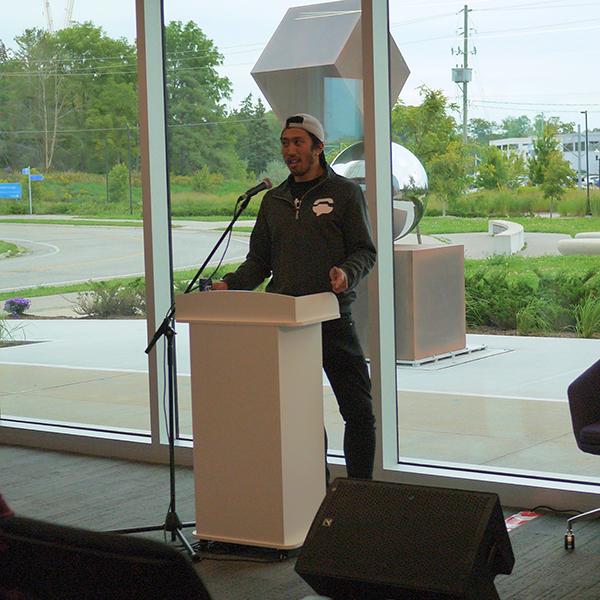
Building instead of pitching
TextNow also took a different path to financing its growth.
“We took a very unorthodox approach because I never enjoyed the process of raising capital,” he said. “I’d always rather build things than make PowerPoint decks.”
For Ting, the better pitch was the product itself.
“I always just gravitated to making products, making solutions to people’s problems,” he said.
That philosophy has stayed with him as TextNow has grown.
“People will always have problems and will always need help solving them,” he said. “When you have the solution, that’s how you get paid.”
TextNow says it remains profitable, having largely financed its growth through revenue generated by the business.
Connected to Waterloo
TextNow reaches millions of consumers across North America, but its headquarters haven’t strayed from where its story began in Waterloo.
“This is our home base,” Ting said.
TextNow has called its current Waterloo office home since 2018, keeping it close to the University of Waterloo campus where Ting studied and to a talent pool he sees as a competitive advantage.
“Every year we get a new cohort of extremely smart and motivated students willing to solve interesting problems,” he said. “It’s a deliberate thing that we haven’t moved far away.”
Dialling up the ambition
If $1 billion sounds like a finish line, Ting doesn’t see it that way.
“Our vision is that not only talk and text will be free, but we’ll make mobile data free,” he said.
The company has an even bigger long-term target. Ting wants one in 10 phone numbers in the U.S. to eventually be TextNow numbers.
“That is our big vision,” Ting said. “So we’re not anywhere near done.”
For the next generation of founders in Waterloo Region, Ting’s advice sounds a lot like the way his own story began.
“It would be awesome to see more people follow their creativity and passion and try to make their own thing happen,” he said. “All you have to do is start small and have fun, and it can grow into big things.”